How the Master Association Used Emergencies, Licensing, and the Classroom to Take Over the Neighborhood
Meta description: Iserbyt’s paper trail shows how federal grants turned classical schooling into behavior modification, and how rights became permits.
In our first look at the Master Association model of American government, we laid out the original blueprint of 1787.
In that three-ring design, you are the homeowner on your lot, your State is your local neighborhood association, and the Federal Government in Washington, D.C., is the Master Association, a hired management agent operating out of a ten-mile-square clubhouse ceded by Maryland and Virginia to handle a strict, 18-clause maintenance and security checklist.
Under the original CC&Rs (the Constitution and the Tenth Amendment), the rules were unmistakable:
- The property owners and their local neighborhoods held all original ownership and general authority.
- The Master Association was allowed to perform only the chores written down in Article I, Section 8.
- Anything not on that written list belonged to the states or to the people as a matter of inherent right.
Look out your window today, however, and you will see the exact opposite arrangement.
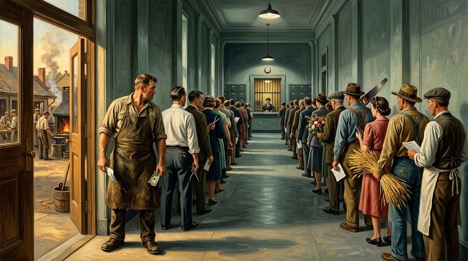
Today, if you want to cut a neighbor’s hair for money, braid hair, arrange flowers in certain states, build a porch on your own house, collect rainwater in certain jurisdictions, or open a small shop, you cannot simply do it as a free owner on your own lot. First, the government declares the everyday activity unlawful by default. Then, it opens a Permit Window and offers to rent your own right back to you, provided you pay an application fee, pass a compliance inspection, renew your license every year, and obey the conditions written in fine print by an unelected board.
Even more startling, the Master Association (which has zero authority over schooling anywhere in its 18 constitutional clauses) now steers the curriculum, psychological testing, and workforce training of the neighborhood’s children through billions of dollars in conditional federal grants.
How did a republic of property owners living by right get transformed into a managed development of tenants living by permission?
It did not happen in a single midnight coup. It happened across four distinct historical waves: beginning with the martial-law machinery of the 1860s, accelerating through a fateful five-line rewrite of wartime law in March 1933, expanding through the rise of the licensing state, and cementing itself inside the modern classroom.
When you translate each of these historical milestones into the language of a Homeowners Association, the entire blueprint snaps into focus.
Act I: The 1860s: Martial Law, Receivership, and Clubhouse Scrip
Every property owner who has ever dealt with a power-hungry HOA board knows the board’s favorite word: Emergency.
In calm weather, the board has to follow the bylaws. When a crisis hits the development, however, the board president steps up to the microphone and announces that normal rules are “temporarily suspended” to save the community. Once the crisis ends, the emergency powers somehow never go back in the drawer.
In American history, the first great structural rewrite of the Master Association happened between 1861 and 1868, during the Civil War and Reconstruction. When eleven southern member associations tried to walk out of the development, President Abraham Lincoln and the Union Congress did not simply fight to preserve the perimeter. They forged a brand-new set of emergency legal tools that permanently altered how the Master Association dealt with all states and all homeowners.
1. The Lieber Code (1863): The Board Writes a Rulebook for Martial Law
In the spring of 1863, with Union armies occupying vast stretches of territory, the Lincoln administration needed a legal framework for governing populations under military control. Lincoln commissioned the German-American legal scholar Franz Lieber to draft General Orders No. 100, signed by the President on April 24, 1863, and known ever since as the Lieber Code.
In HOA terms, the Lieber Code was the first official “Emergency Security Protocol” written by the Master Association’s President without waiting for a bylaw amendment.
Look at what the first articles of the Lieber Code established:
- Martial Law as the Suspension of the CC&Rs: Article 1 defined martial law as “simply military authority exercised in accordance with the laws and usages of war.” Article 3 declared that martial law “suspends the criminal and civil law, and the domestic administration and government in the occupied place or territory, as far as military necessity requires this suspension, and substitutes thereupon military rule and force for the same.”
- The Doctrine of “Military Necessity”: Article 14 defined military necessity as “those measures which are indispensable for securing the ends of the war.”
For the first time in American life, the executive head of the Master Association codified a legal mechanism by which ordinary constitutional limits could be set aside by executive declaration whenever “necessity” demanded it. Alongside the Lieber Code, Congress passed the Habeas Corpus Suspension Act of 1863 and the Enrollment Act of 1863 (the first federal military draft, reaching straight past the state militias to conscript individual homeowners directly).
2. The Reconstruction Acts (1867 to 1868): Putting Member Associations into Receivership
What happens in the corporate world when a local chapter goes bankrupt or rebels against the parent organization? The parent board puts the local chapter into receivership, firing the local board of directors, installing an outside trustee to run the building, and refusing to hand the keys back until the local chapter rewrites its bylaws to the parent board’s liking.
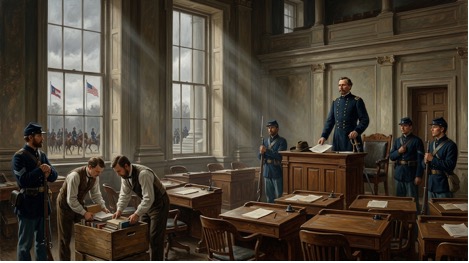
In March 1867, over President Andrew Johnson’s vetoes, Congress passed the Reconstruction Acts. Look at what the Master Association did to ten of the original member states:
- Abolished the Local Boards: Congress declared that no legal state governments existed in those ten states.
- Installed Military Property Managers: Congress erased the state lines for administrative purposes and carved the region into five military districts, placing a Union general in command of each district with the power to use military commissions instead of local civilian courts.
- Forced a Bylaw Rewrite at Gunpoint: Congress informed the occupied states that their representatives would not be allowed back into the Master Association boardroom until each state held a new constitutional convention (supervised by the military commander), wrote a new state constitution acceptable to Washington, and ratified the Fourteenth Amendment.
Whatever one thinks of the moral necessity of abolishing slavery after the war, the structural shift inside the HOA architecture was seismic. Before 1861, the states were the unquestioned creators of the federal agency, and the Bill of Rights restricted only the federal government (Barron v. Baltimore, 1833). After the Reconstruction Acts and the Fourteenth Amendment, the roles flipped: the Master Association became the supervisor and judge of every local neighborhood’s internal rules.
3. The Legal Tender and National Banking Acts (1862 to 1863): Introducing “Clubhouse Scrip”
To pay for the war, the Master Association also rewrote the rules on money.
Under the original Constitution (Article I, Section 8 and Section 10), Congress was hired to coin money and fix weights and measures, while states were forbidden to “make any Thing but gold and silver Coin a Tender in Payment of Debts.” Money was tangible property (gold and silver coin) that no board of directors could conjure out of thin air.
In 1862 and 1863, Congress passed the Legal Tender Acts and the National Banking Acts. In HOA terms:
- The Board ran out of real gold coin to pay its security contractors.
- So the Board cranked up a printing press in the clubhouse basement and printed $450 million worth of unbacked paper coupons called Greenbacks.
- By law, the Board forced every homeowner inside the gates to accept those paper coupons at face value for all private debts, while taxing state-chartered bank notes out of existence.
For the first time, the Master Association discovered that it didn’t have to ask the member states for assessments if it could simply print its own Clubhouse Scrip.
Act II: From 1917 to March 9, 1933: How a Foreign-Intruder Rule Was Turned Against the Homeowners
If the Civil War proved that an emergency could temporarily override the bylaws, the events of 1917 and 1933 turned “temporary emergency management” into the permanent operating system of the United States.
Picture our gated development again.
Suppose that in 1917, a violent gang outside the perimeter fence threatens the community. The HOA Board passes a strict wartime security rule: “If an outside enemy infiltrates the property during a war, the Board President has complete authority to freeze the enemy’s bank accounts, seize their goods, and prohibit them from doing business inside our gates.”
To calm nervous homeowners, the Board adds an explicit legal guarantee right into the text of the rule: this emergency power applies only to foreign enemies in wartime, and shall never apply to domestic transactions between homeowners living inside the gates.
Now fast-forward sixteen years to March 1933. There is no foreign army at the gate. Instead, the HOA’s own banking system is collapsing because the Board and its partner banks printed far more paper promises than they had gold in the vault. Homeowners are lining up at the bank window asking for their real gold coins back.
So on a single afternoon, the Board calls an emergency meeting. With only one folded copy of a draft amendment in the room, the Board takes the 1917 “Foreign Enemy” rule, crosses out the limitation protecting homeowners, and inserts a few words so that the rule now applies to “any person within the neighborhood” during “any period of national emergency declared by the President.”
By changing a single paragraph, the Board effectively reclassifies the property owners as potential enemies of the association whenever the President declares an emergency.
The Hard Legislative Trail: Section 5(b) of the Trading with the Enemy Act
That is not an exaggeration, it is the verbatim legislative history of Section 5(b) of the Trading with the Enemy Act (TWEA).
- October 6, 1917 (The Original Wartime Law): Six months after the United States entered World War I, Congress passed the Trading with the Enemy Act (40 Stat. 411). Section 5(b) gave the President broad power to investigate, regulate, or prohibit transactions in foreign exchange and gold or silver. This power applied strictly during time of war, and explicitly excluded any “transaction which is not to be executed in whole or in part within the United States” or purely domestic business among American citizens. Citizens at home were explicitly shielded from enemy-property decrees.
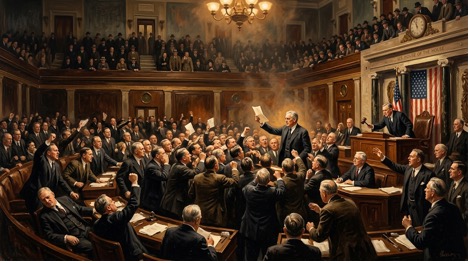
- March 9, 1933 (The Peacetime Rewrite): Five days after Franklin D. Roosevelt took the oath of office in the depths of the Great Depression, he called Congress into an extraordinary emergency session to pass the Emergency Banking Relief Act (48 Stat. 1). There were no printed copies of the bill for members of Congress to read; the Chairman of the House Banking Committee read from a single copy on the floor while members shouted “Vote! Vote!” After just forty minutes of debate in the House, the bill passed both chambers and was signed into law that same evening.
- The Exact Alteration of Section 5(b): Title I, Section 2 of the March 9, 1933 Act amended Section 5(b) of the 1917 Trading with the Enemy Act to read:
“During time of war or during any other period of national emergency declared by the President, the President may, through any agency that he may designate, or otherwise, investigate, regulate, or prohibit, under such rules and regulations as he may prescribe, by means of licenses or otherwise, any transactions in foreign exchange, transfers of credit between or payments by banking institutions as defined by the President, and export, hoarding, melting, or earmarking of gold or silver coin or bullion or currency, by any person within the United States or any place subject to the jurisdiction thereof…”
Read that text again slowly. Look at the three things that happened in a single sentence on March 9, 1933:
- The Trigger Changed: The power was detached from actual war and attached to “any other period of national emergency declared by the President.” The President could now trigger wartime powers simply by signing a piece of paper declaring an emergency.
- The Target Changed: The law no longer targeted only foreign enemies; it now targeted “any person within the United States.”
- The Mechanism Changed: How would the President regulate everyday banking, credit, and money? “By means of licenses or otherwise.”
Less than a month later, on April 5, 1933, President Roosevelt used his newly amended Section 5(b) authority to issue Executive Order 6102, making it a federal crime (punishable by a $10,000 fine and up to ten years in federal prison) for an American homeowner to hold onto their own gold coin, gold bullion, or gold certificates. Citizens were ordered to march into the bank, surrender their physical gold, and accept paper Federal Reserve notes in return. Nine months later, the government devalued the paper dollar by roughly 40 percent against the very gold it had just confiscated.
The Receipt: Senate Report 93-549 (1973)
If a skeptic ever tells you that the March 1933 alteration of Section 5(b) is just an obscure footnote, hand them U.S. Senate Report 93-549, published in November 1973 by the Senate Special Committee on the Termination of the National Emergency, co-chaired by Democratic Senator Frank Church of Idaho and Republican Senator Charles Mathias of Maryland.
When the Church-Mathias Committee audited the federal code in 1973, they made a jaw-dropping discovery: the March 1933 emergency (along with subsequent proclamations in 1950, 1970, and 1971) had never been terminated. Look at the opening words of the official Senate report:
“A majority of the people of the United States have lived all of their lives under emergency rule. For 40 years, freedoms and governmental procedures guaranteed by the Constitution have, in varying degrees, been abridged by laws brought into force by states of national emergency… Under the powers delegated by these statutes, the President may: seize property; organize and control the means of production; seize commodities; assign military forces abroad; institute martial law; seize and control all transportation and communication; regulate the operation of private enterprise; restrict travel; and, in a plethora of particular ways, control the lives of all American citizens.”
Even when Congress responded to that report by passing the National Emergencies Act of 1976 and the International Emergency Economic Powers Act (IEEPA) of 1977, which technically limited TWEA back to wartime on paper, Congress simply copied the peacetime emergency powers into IEEPA and over 120 other statutory emergency provisions. As of today, the United States still operates under dozens of active, simultaneously running Presidential “national emergencies” renewed year after year by signature.
Act III: The Permit Window: A Government of Permission, Not by Right
Notice those five quiet words buried inside the March 9, 1933 rewrite of Section 5(b): “by means of licenses or otherwise.”
In those five words lies the philosophical divide between the republic the Founders built and the administrative state we inhabit today.
In classical common law, the legal air the Founders breathed, there was a crystal-clear line between a Right and a Privilege:
- A Right is something you already own as a free human being and a property owner: working an honest trade to feed your family, traveling down the public road, building a shelter on your land, raising food in your soil, and entering into voluntary contracts with your neighbors. You do not ask the HOA Board for permission to exercise a right; the Board exists to stop trespassers from interfering with your right.
- A Privilege (or Franchise) is a special corporate monopoly or government favor that nobody owns by nature, like operating a toll bridge on public land or acting as an official contractor for the association.
Now look at how the System of Licensing turns a Right into a Privilege inside an HOA:
- Step 1 (The Blanket Ban): The Board passes an ordinance declaring that a normal, peaceful activity (such as repairing plumbing, cutting hair, operating a food cart, or adding a room onto your cottage) is now illegal for everyone unless authorized by the Board.
- Step 2 (The Permit Window): The Board opens a licensing office. If you pay a fee, submit your fingerprints, take Board-approved classes, pass an inspection, and agree to follow pages of administrative code, the Board issues you a License.
- Step 3 (Compliance by Threat): What is the legal definition of a license? Every first-year law student learns it in property law: a license is official permission to do an act that would otherwise be unlawful, revocable at the will of the grantor.
Once you accept that you need a permit to work, build, or trade, you are no longer operating as an owner by right. You are operating as a permittee by permission. And whatever the Board grants by permission, the Board can revoke the moment you refuse a new mandate.
Look at how this permit system expanded across every square inch of American life from the late 19th century through the New Deal and beyond:
1. Licensing Your Livelihood (From 5% to 25% of All Workers)
In early America, anyone could apprentice with a blacksmith, carpenter, cobbler, or barber, hang out a shingle, and earn an honest living. If they did shoddy work, they lost their customers or faced a common-law suit for damages.
Starting in the late 1800s (with cases like Dent v. West Virginia in 1889) and exploding in the post-New Deal era, state and federal boards began wrapping nearly every imaginable trade in licensing red tape.
- In 1950, fewer than 1 in 20 American workers (under 5 percent) needed a government license to go to work.
- Today, roughly 1 in 4 American workers cannot legally earn a paycheck without first buying a license from a government board, including landscape contractors, auctioneers, interior designers, makeup artists, florists (in Louisiana until recently), home inspectors, and African-style hair braiders.

2. Licensing Your Own Soil (Wickard v. Filburn, 1942)
What about your own backyard lot? Surely the Master Association’s power to “regulate commerce among the several states” (Clause 3 of Article I, Section 8) only applies when you actually ship goods across state lines?
Not after 1942. In the landmark Supreme Court case Wickard v. Filburn, an Ohio farmer named Roscoe Filburn grew wheat on his own land. He did not grow it to sell across state lines, or even to sell at a local farmers’ market, but simply to feed his own chickens, livestock, and family on his own farm.
Under the Agricultural Adjustment Act of 1938, the federal government had assigned Filburn an acreage quota, which functioned as a production permit telling him how much food he was allowed to grow on his own dirt. Because he grew 239 bushels more than his federal permit allowed, the federal government fined him.
When Filburn argued that feeding his own grain to his own chickens on his own Ohio farm wasn’t “interstate commerce,” the Supreme Court ruled unanimously against him. Why? Because by growing his own wheat at home, Filburn didn’t buy wheat on the open market, and if millions of homeowners grew their own food instead of buying it at the store, that would affect the national price of wheat!
Translate Wickard v. Filburn into the HOA analogy and see how absurd it looks: The HOA Board fines you for growing tomatoes in your own backyard garden to make your own dinner salad, on the grounds that eating your own tomatoes reduces foot traffic at the HOA-regulated grocery store. Once the Supreme Court decided that not engaging in commerce counts as “interstate commerce,” the 18-clause fence around the Master Association vanished.
3. The Unaccountable Property Management Company (The Administrative State)
Worse still, who actually writes and enforces all these permits, quotas, and fines today? Not your elected representatives in Congress.
In a sprawling modern HOA, lazy board members eventually get tired of answering angry phone calls from homeowners. So the board hires a massive, permanent Property Management Company. The board passes a vague one-page resolution saying, “Keep the neighborhood safe, clean, and fair,” and hands the clipboard to the management company.
From that day forward:
- Unelected employees inside the management company write thousands of pages of binding rules (exercising legislative power).
- The same management company sends out inspectors to audit your lot and issue citations (exercising executive power).
- When you protest the fine, you don’t even get a real jury trial in an independent court. Instead, you are hauled before an in-house Administrative Law Judge employed by the very same agency that fined you (exercising judicial power).
James Madison warned in Federalist No. 47 that “the accumulation of all powers, legislative, executive, and judiciary, in the same hands… may justly be pronounced the very definition of tyranny.” Yet today, for every single law passed by the elected Congress, federal administrative agencies issue twenty to thirty binding regulations that carry the force of law, backed by civil fines, license revocations, and prison sentences.
