How Federal Grants Turned America’s Schoolhouse Into a Workforce Pipeline

Act IV: The HOA Daycare and Workforce Pipeline: From Classical Education to Behavior Modification
Now put yourself in the shoes of the Master Association Board and its largest industrial partners after they have built this system of emergency decrees, clubhouse scrip, and permit windows.
They still face one massive, recurring problem: the homeowners’ children.
If the children growing up in the fifty neighborhoods are taught the old-fashioned way (learning to read difficult texts through intensive phonics, studying formal logic and rhetoric, reading the primary documents of the Founding, mastering arithmetic and contract law, and answering to an independent moral conscience), what happens when they turn eighteen?
They pick up the original 1787 CC&Rs, read the 18 clauses of Article I, Section 8, look at the Master Association Board, and say: “Wait a second. Where in the governing documents did anybody give you the authority to do any of this?”
Even more practically, a centralized economy run by giant corporate combines and sprawling government bureaus does not want millions of fiercely independent homesteaders, self-employed craftsmen, and contrarian constitutional lawyers. As the industrial revolution matured, the growing factories and administrative bureaus needed something very specific: predictable, standardized, compliant human resources who would show up at the bell, follow instructions without questioning the management structure, adjust smoothly to group consensus, and fill the exact vocational slots the Master Association needed filled.
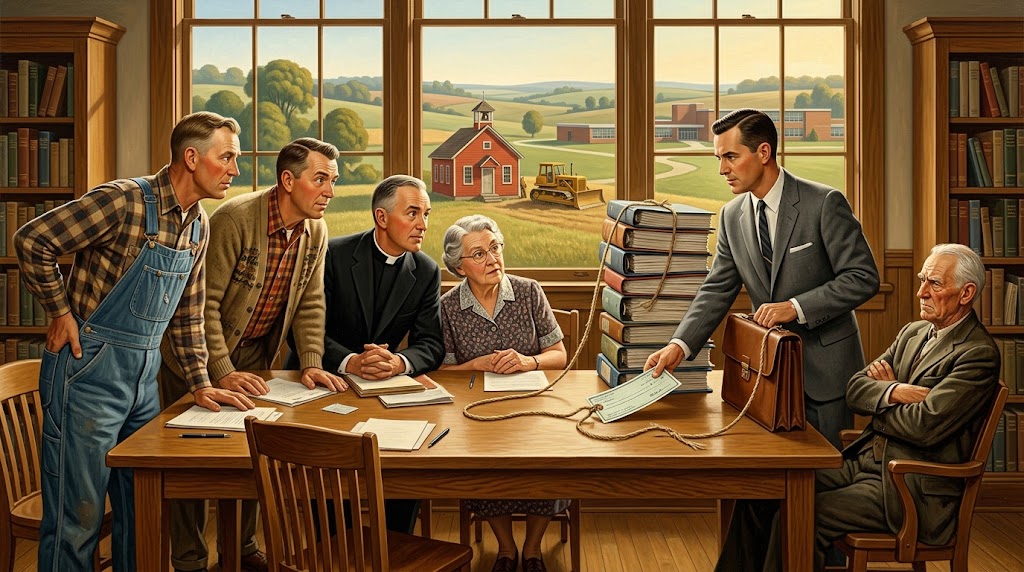
So the Master Association and its allied corporate foundations made a historic decision. Even though the word “Education” does not appear a single time in the U.S. Constitution, the Master Association decided to take over the neighborhood schoolhouse, not by marching soldiers into the classroom, but by buying the curriculum with federal grants and replacing traditional academic instruction with behavioral psychology.
The Insider’s Receipt: The Deliberate Dumbing Down of America
You do not have to guess at how this happened, because a senior federal official walked out of the building with the filing cabinets.
During the Reagan administration, Charlotte Thomson Iserbyt served as Senior Policy Advisor in the Office of Educational Research and Improvement (OERI) inside the U.S. Department of Education, the exact division where federal pedagogical grants, psychological testing pilots, and curriculum reforms were designed and funded. When she realized what the internal government documents, foundation grants, and contractor manuals actually said, she preserved the primary sources and published them in her landmark 1999 book, The Deliberate Dumbing Down of America: A Chronological Paper Trail (DDOA).
Using the HOA analogy, trace the exact two-track strategy documented in that historical paper trail: First, change the psychology of the classroom from academic mastery to behavior modification; second, use federal HOA matching funds to lock every local school board into the system.
Track 1: From Educating the Mind to Conditioning the Herd (Wundt, Thorndike, Skinner, and Bloom)
In the early American republic, local schools were funded and controlled completely by parents and local towns. Their goal was cognitive mastery and individual character: teaching a child what the facts of history, science, mathematics, and language are, and how to think logically and independently.
Beginning in the late 19th century, American educational theorists traveled to Germany to study under Wilhelm Wundt at the University of Leipzig, where experimental psychology divorced the study of the human mind from the concept of a free human soul. To Wundt and his disciples, a human being was not a self-governing moral agent with inalienable rights; a human being was a biological organism responding to external stimuli.
When Wundt’s American students returned home to head the psychology and education departments at Columbia Teachers College, the University of Chicago, and Harvard, they partnered with major industrial philanthropies (such as the Carnegie and Rockefeller foundations) to redesign American schooling from the ground up:
- Edward Thorndike (Animal Training in the Classroom): At Columbia Teachers College, Thorndike conducted laboratory experiments training chickens, cats, and dogs in puzzle boxes using food rewards and punishments, then explicitly transferred those exact stimulus-response (S-R) conditioning laws to the training of schoolchildren.
- John Dewey (Socialization Over Individual Literacy): Dewey argued that traditional schools placed far too much emphasis on individual reading, independent scholarship, and competing for excellence, and that the primary task of the school was to socialize the child into a cooperative member of the collective workforce.
- B.F. Skinner (Operant Conditioning): At Harvard, Skinner perfected operant conditioning on pigeons and laboratory rats in “Skinner boxes,” reinforcing desired behaviors in small, programmed steps until the subject performed automatically. As Iserbyt documented, Skinner’s Programmed Instruction became the direct blueprint for federal computer-assisted learning and Mastery Learning grants in the 1960s, 70s, and 80s.
- Benjamin Bloom (Taxonomy of Educational Objectives, 1956) & Outcome-Based Education (OBE): Under traditional education, a school tested the cognitive domain: can the student solve the equation, spell the word, and state the date the Constitution was ratified? Bloom and his behavioral-science colleagues shifted the focus to the affective domain, testing and reshaping the child’s attitudes, values, feelings, and beliefs. Under Outcome-Based Education (OBE) and Mastery Learning, a student isn’t graded simply on mastering objective facts; they are cycled through “remediation” loops until they demonstrate the state-approved social attitudes and behavioral “outcomes.”
In HOA terms: the neighborhood school stopped teaching the kids how to read the property deed and audit the HOA’s books, and started training them how to be polite, compliant team players on the HOA landscaping crew.
Track 2: How the Master Association Bought the Local Schools (1862 to 1994)
How did the federal government, which had zero constitutional authority over schools, get fifty states and 13,000 local school boards to adopt this workforce-conditioning model?
By using the exact same financial trick an overbearing Master Association uses on cash-strapped neighborhood boards: tax the homeowners directly, keep the money in Washington, and then offer to give a slice of the homeowners’ own money back to the local school, if and only if the school adopts the Master Association’s workforce program.
Look at the legislative stepping stones:
- 1862 (The First Morrill Land-Grant Act): Passed during the Civil War right alongside the Legal Tender Acts, the Master Association used federal land grants to steer higher education toward agricultural and mechanical arts needed for national industrial growth.
- 1917 (The Smith-Hughes National Vocational Education Act): Passed in the exact same year as the Trading with the Enemy Act, this was the first time the federal government reached into pre-college K-12 schools with federal matching funds. Its explicit purpose? To train high schoolers for industrial, trade, and agricultural labor slots, requiring states to create federal-approved vocational boards to get the money.
- 1958 (The National Defense Education Act, or NDEA): Once again, the Board used an Emergency, the Soviet launch of the Sputnik satellite, to break through the constitutional wall on general K-12 schooling. Under the banner of “National Defense,” the Master Association poured money into local schools not just for science labs, but for standardized psychological testing and guidance counseling designed to identify, sort, and track students into national manpower categories.
- 1965 (The Elementary and Secondary Education Act, or ESEA): The Master Association turned on a permanent financial firehose (Title I funds). Once local school budgets became addicted to federal dollars for 8 to 12 percent of their operating costs, no local school board dared say no to a federal curriculum or testing mandate.
- 1979 (Creation of the U.S. Department of Education): Despite the Tenth Amendment, Congress elevated federal education control to a full Cabinet-level Department, creating a permanent headquarters in the D.C. clubhouse to coordinate research grants, behavioral laboratories (like the regional educational labs Iserbyt exposed), and national standards.
- 1994 (Goals 2000 & The School-to-Work Opportunities Act): Signed into law together in 1994, these acts explicitly merged education policy with the U.S. Department of Labor. Under the School-to-Work framework, K-12 schools were no longer treated primarily as academic institutions for free citizens; they were officially restructured as part of a unified “workforce development system” designed to match children’s skills and attitudes to labor-market quotas set by government-business partnerships.
Act V: The Master Ledger: From the Founders’ Blueprint to the Permission State
When you lay all four of these historical shifts end to end, you can see the entire transformation of the American republic in a single glance:
| Area of Life | The Founders’ Blueprint (By Right) | The HOA Analogy of the Shift | The Legal / Historical Turning Point | The Modern Reality (By Permission) |
| Emergency & Executive Power | Strict enumerated powers in peace and war; rights stay intact unless invasion or rebellion suspends habeas corpus by Congress | The Board President declares a permanent “neighborhood security emergency” that suspends the normal CC&Rs indefinitely | Lieber Code (1863); TWEA § 5(b) amended March 9, 1933; Senate Report 93-549 (1973); IEEPA (1977) | Continuous rolling “National Emergencies” declared by executive signature, granting sweeping economic and regulatory decrees |
| Status of the Member States | Self-governing principals who created the federal agent and control the Senate | The Master Association puts rebellious local boards into military receivership, then cuts all local boards out of the Senate | Reconstruction Acts (1867 to 1868); 14th Amendment (1868); 16th & 17th Amendments (1913) | States act largely as administrative sub-contractors competing for federal matching grants with strings attached |
| Money & Savings | Gold and silver coin; no state may make anything else legal tender; no unbacked federal paper currency | The Board bans real gold inside the gates, confiscates homeowners’ coins, and forces everyone to use “Clubhouse Scrip” | Legal Tender Acts (1862 to 1863); Federal Reserve Act (1913); Emergency Banking Act & EO 6102 (1933) | Fiat paper and digital currency managed by a central banking cartel, subject to steady inflation (an invisible assessment) |
| Working a Trade | Common-law right to pursue any honest calling without asking the government first | The Board bans working on your own lot, then sells you an annual “Work Permit” it can revoke if you disobey | Dent v. West Virginia (1889) through 20th-century administrative licensing explosion | 1 in 4 American workers must buy a government license or permit just to legally earn a living |
| Using Your Own Land | Full dominion over your own parcel; federal commerce power stops at actual interstate trade | The Board fines you for growing vegetables in your own backyard because you aren’t buying food at the HOA store | Wickard v. Filburn (1942) & federal environmental/land-use mandates | What you grow, build, or modify on your own private land is treated as “interstate commerce” subject to federal quotas and local permits |
| Rulemaking & Courts | Laws passed only by elected Congress; disputes tried before an independent judge and a jury of your peers | The Board hires an outside Property Management Company to write rules, issue fines, and judge appeals in its own back room | New Deal Agencies (1930s); Administrative Procedure Act (1946) | Unelected alphabet agencies write 20x more binding rules than Congress and prosecute citizens in administrative tribunals |
| Educating Your Children | Zero federal role; local parents and communities teach classical literacy, logic, history, and moral conscience | The HOA needs compliant workers for its partner factories, so it funds local schools on condition they switch to behavioral conditioning | Smith-Hughes Act (1917); NDEA (1958); ESEA (1965); Dept. of Ed (1979); School-to-Work (1994) (documented in DDOA) | Federally funded Outcome-Based Education (OBE), psychological tracking, and workforce-alignment pipelines |
Act VI: How to Keep Your Argument Bulletproof (A Note for the Reader)
If you publish or share this history, you are going to rattle people, because most Americans were never taught a word of it in school (for reasons we just covered in Act IV).
Because this material touches on the real legal history of the Lieber Code, Section 5(b) of the Trading with the Enemy Act, and the licensing state, you should also know how critics will try to dismiss your argument, and how you can keep your footing on 100 percent solid historical ground:
- Cite Official Government Records, Not Internet Rumors: When you talk about the March 9, 1933 alteration of Section 5(b) of the Trading with the Enemy Act, quote directly from the Statutes at Large (48 Stat. 1) and U.S. Senate Report 93-549 (1973). Nobody can call Senators Frank Church and Charles Mathias “conspiracy theorists” for publishing an official bipartisan Senate report proving that the United States had been living under continuous emergency rule since March 1933.
- Don’t Confuse a Structural Diagnosis with a Courtroom Trick: Over the years, various courthouse “gurus” have read the real history of the Lieber Code, the 14th Amendment, and TWEA Section 5(b) and told people they can walk into a modern traffic court or tax court, recite a magic phrase about “admiralty law” or “rescinding their license,” and make the judge dismiss the case. Do not fall for that trap. Remember Fault Line #2 from our first essay: in this HOA, the Board appoints and pays the judges. A federal or state judge works for the existing legal system and will sanction anyone who tries to use historical compact theory as a courtroom loophole. The value of this history is educational, civic, and political: waking up the homeowners so they understand how the bylaws were changed, rather than pretending the current Board doesn’t have tow trucks.
- Keep the Focus on Consent and Agency: The power of the HOA analogy is that everyone, whether left, right, or independent, immediately understands what it feels like to deal with an arrogant board of directors that forgot who pays the assessments. When you frame the shift from 1787 to today as a story of a hired property-management agent gradually locking the owners out of the boardroom, turning rights into revocable permits, and retraining the neighborhood kids to work for the board, even people who usually tune out politics lean in and listen.
The Choice Left to the Homeowners
Look back at the three rings of our neighborhood one last time.
In 1787, the arrows of authority pointed outward: from the free homeowner on their lot, through their self-governing state community, to a strictly limited federal management office hired to carry out 18 specific tasks. You worked by right, built by right, traded in real coin by right, and raised your children according to your own conscience.
Step by step, through the martial-law precedents of 1863 and 1867, the peacetime emergency switch of March 9, 1933, the spread of the licensing window, and the behavioral conditioning of the modern schoolhouse, every single one of those arrows was turned inward. Today, the Master Association prints the scrip, renews its own emergencies, issues the permits, subsidizes the curriculum, and judges its own authority.
The first step toward restoring any neighborhood is simple: the homeowners have to pull the original deed out of the county courthouse, read the original bylaws out loud, and remember who actually owns the land.
Primary Sources & Historical Documentation Appendix
- General Orders No. 100 (The Lieber Code), April 24, 1863: Yale Law School Avalon Project (avalon.law.yale.edu)
- The Reconstruction Acts of 1867 to 1868: 14 Stat. 428 (March 2, 1867)
- The Legal Tender Act of 1862: 12 Stat. 345 (February 25, 1862)
- Trading with the Enemy Act of 1917, Section 5(b): 40 Stat. 411, 415 (October 6, 1917)
- Emergency Banking Relief Act of March 9, 1933 (Amending TWEA § 5(b)): Public Law 73-1, 48 Stat. 1
- Executive Order 6102 (Forbidding the Hoarding of Gold Coin, Gold Bullion, and Gold Certificates): April 5, 1933
- U.S. Senate Report 93-549: Emergency Powers Statutes: Provisions of Federal Law Now in Effect Delegating to the Executive Extraordinary Authority in Time of National Emergency: Special Committee on the Termination of the National Emergency, 93rd Congress, 1st Session (November 19, 1973)
- Wickard v. Filburn: 317 U.S. 111 (1942)
- Smith-Hughes National Vocational Education Act of 1917: Public Law 64-347, 39 Stat. 929
- National Defense Education Act of 1958 (NDEA): Public Law 85-864, 72 Stat. 1580
- Elementary and Secondary Education Act of 1965 (ESEA): Public Law 89-10, 79 Stat. 27
- School-to-Work Opportunities Act of 1994: Public Law 103-239, 108 Stat. 568
- Iserbyt, Charlotte Thomson: The Deliberate Dumbing Down of America: A Chronological Paper Trail. Ravenna, OH: Conscience Press, 1999.
