Part 2: How the Door Was Blown Open
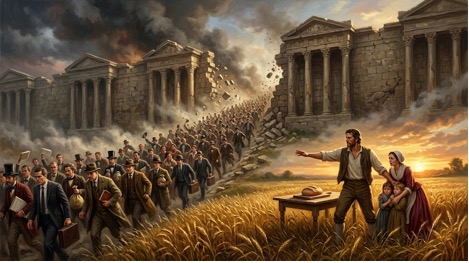
The courts reread the spending clause in 1936. But the wall had already been breached three years earlier, through a different gate. It came by way of a war law, a banking panic, and the gold in ordinary Americans’ pockets.
1913: The Year the Machinery Arrived
Two things happened in 1913 that made everything after possible.
In February, the Sixteenth Amendment was ratified, giving Congress the power to tax incomes. The top rate that first year was 7 percent, on incomes over $500,000. Most Americans paid nothing.
In December, Congress passed the Federal Reserve Act, creating a central bank to manage the nation’s money and credit.
A government with an income tax and a central bank can raise money and create credit on a scale the founders never imagined. The breach Williamson feared now had the machinery to widen it.
The Depression: “You’re Right, We Did It”
The Federal Reserve was sold to the country as a guardian against banking panics. Then came the worst banking panic in American history.
Between the fall of 1929 and 1933, about 9,000 banks suspended operations. Depositors lost about $1.3 billion. In their landmark A Monetary History of the United States (1963), Milton Friedman and Anna Schwartz showed that the nation’s money stock fell by more than a third from August 1929 to March 1933, more than triple any earlier decline.
The Fed did not stop it. In October 1931, in the middle of a wave of bank failures, the New York Fed raised its discount rate from 1.5 percent to 2.5 percent, then to 3.5 percent a week later. That October alone, 522 banks closed.
For decades this was argued as economic theory. Then, on November 8, 2002, a sitting Federal Reserve governor (and future Fed chairman), Ben Bernanke, spoke at a celebration of Milton Friedman’s ninetieth birthday. Speaking for the institution, he said:
“Regarding the Great Depression. You’re right, we did it. We’re very sorry. But thanks to you, we won’t do it again.”
That is the Federal Reserve’s own leadership admitting that the guardian built to prevent the catastrophe had caused it.
The institution had its accusers long before that. In June 1932, Representative Louis McFadden, who had chaired the House Banking and Currency Committee until 1931, stood on the House floor and called the Federal Reserve “one of the most corrupt institutions the world has ever known.” He was a banker himself and had spent a decade overseeing the system. He moved to impeach the Board.
Many critics go further still and charge that the crisis was engineered on purpose, so that its authors could offer the solution. The documented record proves the failure, and proves the Fed’s own later confession. No document yet produced proves the intent. What is documented is who gained from the solution, and that story comes next.
March 1933: A War Law Turned on the American People
By the time Franklin Roosevelt took the oath on March 4, 1933, bank runs were spreading and many states had closed their banks. The panic was real. It was not a war. And it was, by the Fed’s own later admission, largely of the Fed’s own making.
To answer it, the new administration reached for a wartime statute: the Trading with the Enemy Act of 1917. Section 5(b) of that law gave the President power over foreign exchange and the movement of gold to and from foreign countries during the First World War.
On March 6, 1933, Roosevelt issued Proclamation 2039, citing that war law to declare a national emergency and close every bank in the country.
Three days later, on March 9, 1933, Congress passed the Emergency Banking Relief Act, sight unseen by most members, in a single day. Section 1 approved everything the President had done since March 4. Section 2 rewrote the war law. Section 5(b) now read:
“During time of war or during any other period of national emergency declared by the President, the President may… investigate, regulate, or prohibit… any transactions in foreign exchange, transfers of credit between or payments by banking institutions as defined by the President, and export, hoarding, melting, or earmarking of gold or silver coin or bullion or currency, by any person within the United States or any place subject to the jurisdiction thereof.”
A power built for war now operated in any national emergency the President declared. A power aimed at trade with foreign enemies now reached the hoarding of gold and currency by Americans at home. The penalty: up to $10,000 and ten years in prison.
That was the moment. A war power became a peacetime power, and its new target was the citizen’s own savings.
April 1933: Executive Order 6102
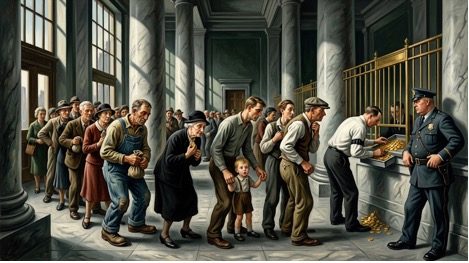
On April 5, 1933, Roosevelt signed Executive Order 6102. Every person in the United States was ordered to deliver their gold coin, gold bullion, and gold certificates to a Federal Reserve Bank, a branch, or a member bank by May 1, 1933. A person could keep only $100 in gold coin, plus jewelry, collectors’ coins, and gold needed in a trade. Violators faced the same $10,000 fine and ten years.
Americans were paid in paper currency at the old legal price of $20.67 an ounce.
Notice where the gold went: to the Federal Reserve, the institution whose failure had brought on the emergency.
June 1933: Contracts Erased
For generations, careful Americans had protected themselves with gold clauses: contract terms requiring payment in gold, or in dollars equal to a fixed weight of gold. Bonds, mortgages, and even U.S. Treasury bonds carried them.
On June 5, 1933, Congress passed House Joint Resolution 192. It declared every gold clause “against public policy” and made all such debts payable dollar for dollar in any legal tender. With one resolution, Congress rewrote millions of private contracts it had no part in making.
1934: The Devaluation and the Profit
On January 30, 1934, the Gold Reserve Act transferred title to all the gold held by the Federal Reserve to the U.S. Treasury. The next day, Proclamation 2072 reset the price of gold to $35 an ounce.
Do the arithmetic. Americans had surrendered their gold at $20.67. Nine months later the government valued it at $35, a gain of 69 percent. Put the other way, the dollar in your pocket was now worth 41 percent less in gold than it had been the year before.
The profit did not go back to the people who turned in their gold. It went to the government. The Gold Reserve Act set aside $2 billion of it to create the Exchange Stabilization Fund, controlled by the Treasury Secretary.
1935: “The Constitution… Is Gone”
The gold clause cases reached the Supreme Court in 1935.
In Perry v. United States, the Court held that Congress had acted unconstitutionally in canceling the gold clause in the government’s own bonds: “Congress has not been vested with authority to alter or destroy those obligations.” Then it held that the bondholder could recover nothing, because he could not prove an actual loss. In Norman v. Baltimore & Ohio Railroad, the Court upheld the cancellation of gold clauses in private contracts.
Justice James McReynolds was so shaken that he departed from his written dissent and spoke from the bench. As commonly reported, he said:
“The Constitution as many of us understood it, the instrument that has meant so much to us, is gone.”
A justice of the Supreme Court said those words from his seat on the Court.
The Emergency That Never Ended
Forty years later, the Senate finally looked at what had been built. A special Senate committee studied the emergency powers that had accumulated since 1933. It found 470 statutes granting the President emergency authority. Its 1973 report, Senate Report 93-549, opens with this sentence:
“Since March 9, 1933, the United States has been in a state of declared national emergency.”
It continues:
“This vast range of powers, taken together, confer enough authority to rule the country without reference to normal constitutional processes.”
And in its introduction:
“A majority of the people of the United States have lived all of their lives under emergency rule.”
Congress responded with the National Emergencies Act (1976) and the International Emergency Economic Powers Act (1977), which finally moved peacetime emergency powers out of the war law. But the system of emergencies did not end. As of October 2026, 51 national emergencies remain in effect. The oldest, declared over Iran in November 1979, has been renewed every year for forty-six years.
Rights Into Privileges
A right is something you hold by nature. A privilege is something a government grants, and can take back, and can charge you for.
The Supreme Court once drew that line sharply. In Murdock v. Pennsylvania (1943) it held:
“A state may not impose a charge for the enjoyment of a right granted by the Federal Constitution.”
Yet across the twentieth century, more and more of ordinary life came to require permission. In the early 1950s, fewer than 5 percent of American workers needed a government license to do their jobs. By 2015, a report from the Treasury, the Council of Economic Advisers, and the Department of Labor found that more than a quarter did. The right to earn a living, to work the trade you learned, became for millions a license to be applied for, paid for, and renewed.
The same pattern runs through the money itself. In 1932 an American could hold gold, the money the Constitution names (“No State shall… make any Thing but gold and silver Coin a Tender in Payment of Debts”). In 1933 holding it became a federal crime. Private gold ownership was not fully restored until 1974.
That is how the breach was opened. A real crisis, caused largely by the Federal Reserve, was answered with a war law turned inward, and the emergency it created never truly ended. Then the money began to pour through.
What Came Through the Breach
Williamson said it would not be a few fishermen. It would be “all manner of persons; people of every trade and occupation.” Here is the roll call.
“A Hopeless Indebtedness”
In 1847, President Polk warned that combinations of local interests would “absorb the revenues of the country, and plunge the Government into a hopeless indebtedness.”
Here is where that road has led:
- The national debt passed $40 trillion on August 18, 2026. On October 8, 2026, it stood at about $40.3 trillion. It had passed $38 trillion in October 2025, and $39 trillion in March 2026. That is two trillion dollars of new debt in less than a year.
- In fiscal 2025, Washington spent $7.01 trillion and took in $5.24 trillion. The gap, $1.78 trillion, was borrowed.
- Interest on the debt passed $1 trillion for the first time in fiscal 2025, at $1.03 trillion. That was more than the entire $868 billion spent on the military. In fiscal 2026, by the Congressional Budget Office’s early count, interest rose to $1.14 trillion, against $916 billion for defense.
- Around 1910, federal spending was about 2 percent of the nation’s economy. Today it is about 23 percent.
- About $1.1 trillion a year now flows from Washington to state and local governments in grants: the very thing Madison, Pierce, and Buchanan said the Constitution did not permit.
The nation now pays more to its lenders than to its defenders. The interest alone, money that builds nothing and defends no one, is a tax laid on every American family to pay for spending already done.
George Washington asked us in his Farewell Address to avoid “ungenerously throwing upon posterity the burden which we ourselves ought to bear.” Jefferson called borrowing against our children “swindling futurity on a large scale.” Williamson called it eating “the bread of our children.” Three founders, one warning, and we are living inside it.
Taxation at Every Corner
In December 1787, the Anti-Federalist writing as “Brutus” warned what an unlimited taxing power would become:
“This power, exercised without limitation, will introduce itself into every corner of the city, and country. It will wait upon the ladies at their toilett… it will enter the house of every gentleman, watch over his cellar, wait upon his cook in the kitchen, follow the servants into the parlour, preside over the table, and note down all he eats or drinks; it will attend him to his bed-chamber, and watch him while he sleeps.”
In 1787 that sounded like a fever dream. Now consider the record.
The income tax. In 1913, the federal income tax began at 1 percent on income over $3,000, an amount few working families earned. The top rate was 7 percent. Within five years, to pay for the First World War, the top rate reached 77 percent (1918). In 1944 it hit 94 percent. From 1951 through 1963 it never fell below 91 percent. It sat at 70 percent from 1965 through 1980. Today the top rate is 37 percent, and the tax that once touched only the very rich reaches nearly every working household.
Withholding. In 1943, the Current Tax Payment Act began taking taxes out of paychecks before workers ever saw the money. It was a wartime measure. It was never repealed. One of the economists who helped design it was a young Treasury staffer named Milton Friedman. Decades later he wrote, with regret, that he had helped build machinery for a government he would come to see as “too large, too intrusive, too destructive of freedom.” As Friedman also observed, “nothing is so permanent as a temporary government program.”
The payroll tax. When Social Security taxes began in 1937, workers and employers each paid 1 percent on the first $3,000 of wages. Today it is 6.2 percent each, plus 1.45 percent each for Medicare, a combined 15.3 percent on wages up to $184,500 in 2026. For a self-employed American, the full 15.3 percent comes out of his own pocket.
And beyond these lie the excise taxes on fuel, telephone service, alcohol and tobacco; the tariffs; and the hidden tax of inflation on every dollar you save. Brutus was not exaggerating. He was early.
The Dollar: Ninety-Seven Cents Gone
The Constitution gave Congress the power “To coin Money, regulate the Value thereof.” It names gold and silver coin as the only things states may make legal tender. The founders understood money as something with a fixed value, like a yardstick or a pound weight.
Here is what has happened to the yardstick:
- A dollar in 1913, the year the Federal Reserve was created, buys what about $34 buys today. The dollar has lost about 97 percent of its purchasing power.
- Gold was $20.67 an ounce before 1933. It was reset to $35 in 1934. On August 15, 1971, President Nixon “closed the gold window,” ending the last link between the dollar and gold. In early October 2026, gold traded around $4,186 an ounce, about 200 times its 1933 price.
The gold didn’t become two hundred times more precious. The dollar became that much less.
Who pays? The worker whose wages lag behind prices. The retiree whose savings melt. The young family trying to buy its first home. And who gains? Those first in line for new money, and the largest debtor in the world, the federal government itself, which repays its debts in shrinking dollars.
Jefferson saw it plainly in 1816: “banking establishments are more dangerous than standing armies.”
The Classroom: From Learning to Shaping
In 1792, Madison warned that if Congress could spend on anything, it might “take into their own hands the education of children, establishing in like manner schools throughout the union.” In 1859, Buchanan said flatly that Congress lacked power to spend federal taxes “for the purpose of educating the people of the respective States,” and that if states ever looked to the federal Treasury to maintain “their systems of education,” both governments would be “greatly deteriorated.”
Here is what followed:
- 1965: the Elementary and Secondary Education Act brings federal money into local schools on a large scale.
- 1979: Congress creates the U.S. Department of Education.
- Today: Washington supplies only about 8 percent of K-12 funding, but that 8 percent carries the strings. In 2009, the $4.35 billion Race to the Top program awarded states 40 of 500 points for adopting common academic standards. States competing for the money moved quickly to adopt them.
The change was not only in who pays. It was in what schools were for.
The great foundations led the way. In 1913, the same year as the income tax and the Federal Reserve, Frederick T. Gates of John D. Rockefeller’s General Education Board published The Country School of To-Morrow. In it he wrote:
“In our dream, we have limitless resources, and the people yield themselves with perfect docility to our molding hand.”
That was private money speaking, not federal money, but the vision travelled. In 1964, educators led by Benjamin Bloom published the Taxonomy of Educational Objectives, Handbook II: Affective Domain, a framework for classroom goals aimed not at knowledge but at students’ attitudes, values, and feelings. In 1968, under a U.S. Office of Education contract, Michigan State University produced the Behavioral Science Elementary Teacher Education Program (BSTEP), a federally funded plan to train teachers in behavioral science methods.
Charlotte Iserbyt served as a senior policy advisor in the U.S. Department of Education’s research office early in the Reagan administration. She spent the rest of her life documenting what she found there. Her 1999 book, The Deliberate Dumbing Down of America, charges that federal education policy shifted schooling from the teaching of knowledge and reasoning toward behavior modification, the shaping of attitudes and conduct. She built that charge from the government’s own documents, which she reproduced at length.
The founders were educated in the classical tradition: grammar, logic, and rhetoric. They learned how to think, and then they thought for themselves. Look at what they built. Then ask what kind of citizen a schoolroom designed to shape attitudes is meant to produce.
Wars Without End, Abroad
No founder spoke more clearly about war and liberty than Madison, in his “Political Observations” of April 20, 1795:
“Of all the enemies to public liberty war is, perhaps, the most to be dreaded, because it comprises and develops the germ of every other. War is the parent of armies; from these proceed debts and taxes; and armies, and debts, and taxes are the known instruments for bringing the many under the domination of the few.”
Armies, debts, and taxes. Every piece of this story has run through that chain. The income tax top rate leapt to 77 percent for the First World War. Withholding arrived with the Second. The emergency law that seized Americans’ gold was a war law.
Washington, in his Farewell Address, urged Americans to keep with foreign nations “as little political connection as possible,” and to avoid “those overgrown military establishments which, under any form of government, are inauspicious to liberty.” John Quincy Adams said of America on July 4, 1821: “she goes not abroad, in search of monsters to destroy.”
Then hear the general who commanded the largest invasion in history. In his Farewell Address of January 17, 1961, President Dwight D. Eisenhower warned:
“In the councils of government, we must guard against the acquisition of unwarranted influence, whether sought or unsought, by the military-industrial complex.”
The record since:
- Congress last declared war on June 5, 1942.
- America has since fought in Korea, Vietnam, the Persian Gulf, Afghanistan, Iraq, and many smaller theaters, under authorizations, resolutions, or no congressional vote at all.
- The Costs of War project at Brown University estimates the post-9/11 wars alone have cost more than $8 trillion, spent and obligated.
Armies, debts, and taxes, just as Madison said.
Experiments on Unknowing Americans
A government that answers to the people would never approve what follows. A government with an unlimited budget and little oversight could fund it quietly for decades. These are not rumors. Each is documented by the government’s own records, admitted by its own officials, or both.
The Tuskegee Study (1932–1972). The U.S. Public Health Service followed 600 Black men in Macon County, Alabama, 399 of them with syphilis. They were never told they had it. By 1943, penicillin was the treatment of choice; the men were never offered it. The study ran for forty years, until AP reporter Jean Heller exposed it in July 1972 from documents leaked by whistleblower Peter Buxtun. In 1997, President Clinton apologized: “The United States government did something that was wrong.” To the survivors he said, “You did nothing wrong, but you were grievously wronged.”
Guatemala (1946–1948). Public Health Service researchers deliberately exposed about 1,300 people (prisoners, psychiatric patients, soldiers, sex workers) to syphilis, gonorrhea, or chancroid. Only about 700 were documented as treated. At least 83 died, though the presidential commission that later studied the experiments could not determine whether the experiments caused those deaths. The commission titled its 2011 report “Ethically Impossible.” The U.S. government formally apologized in 2010.
MKUltra (CIA, 1953–1973). The Central Intelligence Agency ran 149 subprojects at 80 institutions, including 44 colleges and universities, testing drugs and mind-control techniques, including on unwitting American citizens. Army scientist Frank Olson was secretly given LSD at a CIA meeting in 1953 and died about a week later in a fall from a New York hotel window. In January 1973, CIA Director Richard Helms ordered the program’s records destroyed. A surviving cache, misfiled elsewhere, brought the program to light. At a 1977 Senate hearing, Senator Edward Kennedy said the CIA had “drugged American citizens without their knowledge or consent.”
The plutonium injections (1945–1947). Eighteen people, hospital patients in Tennessee, Illinois, New York, and California, were injected with plutonium to study its effects on the human body. The government’s own Advisory Committee on Human Radiation Experiments documented these cases in its 1995 final report.
Edgewood Arsenal (1955–1975). About 7,000 American soldiers were exposed to more than 250 chemicals, including nerve agents and LSD-type drugs, according to Defense Department figures reported by the Department of Veterans Affairs.
Operation Sea-Spray (1950). For eight days in September 1950, a Navy ship sprayed bacteria over San Francisco in a biological-warfare test. Eleven patients at a local hospital developed rare Serratia infections, and one, Edward Nevin, died. His family sued; a federal appeals court ruled in 1983 that the government was immune. The link between the test and his death was argued, never proven in court.
Polk warned that public money would be “abstracted by tariffs and taxes from the earnings of the whole people.” He could not have imagined it would also pay for this.
The Invisible Government
In 1917, the federal government created the Committee on Public Information, the first great federally funded propaganda agency, to sell the First World War to the American people. One of the young men who worked for it, in its Latin American news service, was Edward Bernays.
Bernays went on to become the father of modern public relations. In 1928 he published a book with a plain title, Propaganda. Its opening pages read:
“The conscious and intelligent manipulation of the organized habits and opinions of the masses is an important element in democratic society. Those who manipulate this unseen mechanism of society constitute an invisible government which is the true ruling power of our country.”
And:
“We are governed, our minds are molded, our tastes formed, our ideas suggested, largely by men we have never heard of.”
Bernays was not warning against this. He was describing his profession, and selling it.
Put his words beside Gates’s “molding hand” in the classroom and Madison’s warning about “teachers in every state.” A people whose schooling shapes their attitudes, and whose opinions are managed by men they never see, will not easily notice the breach, let alone close it.
Cradle to Grave
Milton Friedman, the Nobel Prize-winning economist, titled the fourth chapter of his 1980 book Free to Choose “Cradle to Grave.” It described the welfare state that now follows Americans from the maternity ward to the nursing home, and what it costs.
Friedman’s warnings fit in a sentence each:
- “Concentrated power is not rendered harmless by the good intentions of those who create it.”
- “One of the great mistakes is to judge policies and programs by their intentions rather than their results.”
- “Nothing is so permanent as a temporary government program.”
Thomas Sowell, the economist and senior fellow at the Hoover Institution, put the politics of it even more sharply. “The first lesson of economics is scarcity,” he wrote. “The first lesson of politics is to disregard the first lesson of economics.” And elsewhere: “The welfare state is the oldest con game in the world.” First, he explained, the government quietly takes people’s money, then flamboyantly gives some of it back.
Sowell also named the cost in human terms. He wrote that the vastly expanded welfare state of the 1960s “destroyed the black family, which had survived centuries of slavery” and generations of racial oppression.
Now hear Pierce again, from 1854, warning that federal charity would leave “the fountains of charity… dried up at home.” And Cleveland, in 1887, warning that federal aid “encourages the expectation of paternal care on the part of the Government and weakens the sturdiness of our national character.”
The presidents of the nineteenth century and the economists of the twentieth arrived at the same place. A government that supports the people slowly unmakes the people who support it.
Laws for the Few
Madison saw this one coming too. In Federalist No. 62, he warned of a government whose constant changes in law give “the sagacious, the enterprising, and the moneyed few” an advantage over “the industrious and uninformed mass of the people.” Every new regulation of commerce or revenue, he wrote, “presents a new harvest to those who watch the change.” The end of that road, he said, is a state of things in which “laws are made for the FEW, not for the MANY.”
Adam Smith, in The Wealth of Nations (1776), explained why:
“People of the same trade seldom meet together, even for merriment and diversion, but the conversation ends in a conspiracy against the public, or in some contrivance to raise prices.”
Give such people a federal Treasury with no constitutional limit, and they no longer need to raise prices. They can lobby for a share of the taxes. The record:
- The 2008 bailouts. Congress authorized $700 billion for TARP in October 2008. The Federal Reserve’s emergency lending from 2007 to 2010 added up to about $16 trillion in total loan transactions, counting each rolled-over loan every time it renewed, according to the Government Accountability Office. At its peak, more than $1 trillion was outstanding at once.
- Corporate rescue in 2020. Airlines received about $54 billion in payroll support. The Paycheck Protection Program, nearly $800 billion, was sold as help for small business. Publicly traded chains like Shake Shack ($10 million) and Ruth’s Chris ($20 million) received loans before public outcry made them give the money back.
- Hand-picked industries. The CHIPS and Science Act (2022) committed $39 billion in manufacturing incentives to semiconductor makers, including $7.9 billion for Intel. In August 2025, unpaid portions of Intel’s grants were converted into a roughly 10 percent federal ownership stake in the company.
- The squeeze on the small. After the 2010 Dodd-Frank financial law, a Harvard Kennedy School study (2015) found community banks losing their share of the nation’s banking assets at almost double their earlier rate of decline. Big banks can afford armies of compliance officers. The small-town bank cannot.
This is what Williamson meant by gratifying “one part of the Union by oppressing another.” The small business, the family farm, and the community bank pay the taxes and carry the regulations. The best-connected draw out the subsidies.
Jefferson, in 1824, said the country already had “more machinery of government than is necessary, too many parasites living on the labor of the industrious.” In 1776, the Declaration called them “swarms of Officers” sent to “eat out their substance.” Williamson called them all manner of persons, entering at the breach.
They have entered. And they are eating.
The Breach Index
The Breach Index is a recurring feature. Each entry pairs one warning from the men who built or guarded the Constitution with one program running today. Every entry uses the same five questions: What did they warn? What is the program? What does it cost? Who pays? Who benefits? We lay out the facts. You judge whether the warning came true.
Entry 1: The Fishing Bounty, Still Paid
The warning. Williamson, 1792: “It is not a few fishermen that will enter… but all manner of persons.”
The program. The Maritime Security Program pays U.S.-flagged commercial ships to stay ready for military sealift. It is the closest living relative of the 1792 fishing allowance.
The dollar figure. $5.8 million per ship per year (FY2026), for up to 60 ships.
Who pays. Every taxpayer.
Who benefits. Ship operators. Defenders cite the common defense: ships ready for wartime.
Entry 2: Sugar
The warning. Williamson, 1792: Congress may not “gratify one part of the Union by oppressing another.”
The program. The federal sugar program uses price supports and import limits to keep U.S. sugar above world prices.
The dollar figure. An estimated $2.5–3.5 billion a year in higher costs to sugar users (outside studies reviewed by GAO, 2023).
Who pays. Every family at the grocery store, and every food maker.
Who benefits. Domestic sugar growers and processors.
Entry 3: Earmarks
The warning. Polk, 1847: “The Member of Congress who could procure the largest appropriations to be expended in his district would claim the reward of victory.”
The program. Earmarks, renamed “Community Project Funding” and restored in 2021.
The dollar figure. $14.6 billion across 8,098 projects (FY2024, GAO).
Who pays. Taxpayers in every district.
Who benefits. The districts, and the members, who secure them.
Entry 4: The States as Suppliants
The warning. Pierce, 1854: the states will “become humble suppliants for the bounty of the Federal Government.”
The program. Federal grants to state and local governments.
The dollar figure. About $1.1 trillion a year; about 34% of all state spending (FY2024).
Who pays. Taxpayers in every state, and every future taxpayer who inherits the debt.
Who benefits. State budgets that depend on Washington, and the federal agencies that write the conditions.
Entry 5: The Classroom
The warning. Madison, 1792: Congress may “take into their own hands the education of children.”
The program. Race to the Top (2009), competitive grants that rewarded states for adopting common academic standards.
The dollar figure. $4.35 billion, with 40 of 500 points awarded for adopting common standards.
Who pays. Taxpayers, and local control of the classroom.
Who benefits. Washington’s education priorities, now written into state law.
Entry 6: Farm Trade-War Payments
The warning. Cleveland, 1887: federal aid “encourages the expectation of paternal care.”
The program. The Market Facilitation Program (2018–2019) and the Farmer Bridge payments (announced December 2025).
The dollar figure. $23 billion (2018–2019) and $12 billion (2025–2026).
Who pays. Taxpayers.
Who benefits. Farmers compensated for losses caused by federal trade policy.
Entry 7: Crop Insurance
The warning. Polk, 1846: expenditures “benefiting but few at the expense of the common Treasury of the whole.”
The program. Federal crop insurance.
The dollar figure. Taxpayers covered an average of 62% of farmers’ premiums (2008–2017), about $7.4 billion a year in that period.
Who pays. Taxpayers.
Who benefits. Farm operations, with the largest receiving the most.
Entry 8: The Chipmakers
The warning. Jackson, 1834: acts that “proffer local advantages and bring in their train the patronage of the Government.”
The program. CHIPS and Science Act (2022) manufacturing incentives.
The dollar figure. $39 billion, including $7.9 billion for Intel, $6.6 billion for TSMC, $6.2 billion for Micron, and $4.7 billion for Samsung.
Who pays. Taxpayers.
Who benefits. The world’s largest chipmakers. Washington now owns about 10% of Intel.
Entry 9: Boeing’s Bank
The warning. Madison, Federalist No. 62: laws that favor “the moneyed few” until they are “made for the FEW, not for the MANY.”
The program. The Export-Import Bank.
The dollar figure. 70% of its loan guarantees went to Boeing’s customers, FY2007–2014 (Mercatus Center analysis).
Who pays. Taxpayers who back the guarantees, and Boeing’s unsubsidized competitors.
Who benefits. Boeing.
Entry 10: The Interest Bill
The warning. Jefferson, 1816: “spending money to be paid by posterity… is but swindling futurity on a large scale.”
The program. Interest on the national debt.
The dollar figure. $1.03 trillion (FY2025), more than the entire military budget.
Who pays. Every taxpayer now, and every child to come.
Who benefits. Holders of the debt.
Ten warnings. Ten programs. Each warning was written between 1788 and 1887. Each program is running now.
Counting the Cost: What We Can Do
In July 1775, the Second Continental Congress told the world why the colonies had taken up arms. They said they had counted the cost, “and find nothing so dreadful as voluntary slavery.”
Voluntary. That is the word that should stop us. No king took our liberty. We traded it, one local advantage at a time, exactly as Jackson warned. A road here, a bounty there, a grant with strings, an emergency that never ended. Each time, someone stood up and said it was only a little thing, for a good cause. Each time, the wall gave a little more.
The founders did not hand us a perfect government. They handed us a limited one, and the tools to keep it that way. Those tools still work, but only in the hands of citizens who know how to use them.
Here is where to start this week:
- Read the clause yourself. Article I, Section 8: the taxing clause and the eighteen powers that follow. Then read Federalist No. 45. It takes ten minutes. You will know more about the Constitution than most of the people who spend your money.
- Look up your own state’s budget. Find out what share comes from Washington. That number is how dependent your state has become.
- Find the earmarks for your district. The House and Senate Appropriations Committees post the requested projects. See who asked for what.
- Ask your representative one question, in writing. For any program he supports, ask: Which enumerated power authorizes this? Expect a vague answer. Ask again.
- Give where you live. Cleveland trusted the charity of the American people, and he was right to. Every need met by a neighbor, a church, or a local group is a need that does not have to pass through Washington, and a little of the brotherhood Cleveland spoke of, restored.
- Teach your children the clause. Williamson warned about the bread of our children. The least we owe them is the knowledge of how it was taken, and how it might be kept.
The Book of Proverbs says, “A good man leaveth an inheritance to his children’s children” (Proverbs 13:22, KJV). Our founders left us one: a republic of few and defined powers, guarded for a century by men who said no to good causes because they would not break their oath.
We have spent much of that inheritance. We have borrowed against what remains. The question in front of us is the same one Williamson asked in 1792.
Will we close the breach, or will we let it eat the bread of our children?
Sources and Verification Notes (editor’s copy; remove before publishing)
Corrections to the brief
- Jefferson never vetoed a bill (Senate veto count: zero). The post uses his Sixth Annual Message (1806) instead.
- The four Jackson phrases (“dangerous doctrine,” “proffer local advantages,” “sinister appeals to selfish feelings,” “ordinary roads and canals”) are not in the Maysville veto. They come from his Sixth Annual Message, December 1, 1834. The source reads “ordinary roads and canals,” not “ordinary local roads.”
- Monroe conceded more than Madison. His “Views” paper (May 4, 1822) accepted broad appropriation for “general, not local, national, not State” purposes. The post says so.
- Williamson’s speech is dated February 7, 1792 in Elliot’s Debates vol. 4, p. 427, and February 3, 1792 in The Founders’ Constitution (citing Annals 3:378–80). The restored passage (“set aside that part of the Constitution which requires equal taxes, and demands similar distributions; destroy this barrier”) is from Elliot’s. Confirm against the Annals page before print.
- Madison’s 1792 speech: the Madison Papers read “apply money” and “establish teachers”; Elliot’s reads “employ money” and “appoint teachers.” The post uses the Madison Papers text.
- McFadden chaired the House Banking Committee until March 1931. In June 1932 he was a former chairman. The post says so.
- Senate Report 93-549 reads “rule the country,” not “rule this country.” The “lived all of their lives” line is in the Introduction, not the Foreword.
- TWEA §5(b): “by any person within the United States” was already in the 1917 text. What 1933 added was “any other period of national emergency declared by the President” and reach over domestic hoarding, melting of gold and currency.
- EO 6102 does not state $20.67. That was the legal gold price under the Gold Act of 1900, which is what holders received in currency.
Claims tagged by strength
- Documented: the Fed’s failure in 1929–33 (Friedman & Schwartz; Federal Reserve History; Bernanke’s 2002 admission); every statute, order, and veto quoted.
- Charge, not proven: that the Fed caused the crisis on purpose to obtain the 1933 solution. No primary document showing intent has been produced. The post states the charge and states the gap, once.
- Reported, not in the official record: McReynolds’s words were spoken from the bench and do not appear in U.S. Reports. The wording follows Holzer, The Gold Clause (1980), and contemporary accounts.
- Contested: Operation Sea-Spray’s link to Edward Nevin’s death; Guatemala deaths’ cause (the commission could not determine it).
- Non-government sources: Ex-Im/Boeing share (Mercatus Center); Maritime Security Program rates (a law-firm summary of the statute); sugar cost estimates (outside studies reviewed by GAO, not GAO’s own figure).
Left out on purpose (could not verify, or spurious)
- Friedman’s “inflation is taxation without legislation” is a paraphrase. The post uses his documented wording from The Observer, September 22, 1974.
- Friedman’s “weaken the family; reduce the incentive to work, save, and innovate” could not be found in any reachable text of Free to Choose. Not used.
- Bloom’s “challenging the students’ fixed beliefs” quote (All Our Children Learning, 1981, p. 180) circulates through Iserbyt and could not be traced to the book. Not used.
- The claim that private giving to Texas far exceeded the $10,000 seed bill could not be sourced. Removed.
- A Treasury revaluation profit of about $2.8 billion in 1934 is widely repeated but has no official source found. The post uses only the confirmed $2 billion Exchange Stabilization Fund.
- Spurious, never use: Franklin’s “When the people find that they can vote themselves money…”; Jefferson’s “If the American people ever allow private banks to control the issue of their currency…” (Monticello: at least partly spurious); Davy Crockett’s “Not Yours to Give” (an 1867 story by Edward Ellis).
- Date uncertain: Gates’s Country School of To-Morrow is commonly dated 1913; the archive.org copy (GEB Occasional Papers No. 1) reads as 1916.
Primary sources
- U.S. Constitution, Art. I §8 and §10; Declaration of Independence (1776); Declaration of the Causes and Necessity of Taking Up Arms (1775)
- Madison, Federalist 41, Federalist 45, Federalist 62
- Brutus No. 6 (Dec. 27, 1787)
- Jefferson, Opinion on the National Bank (1791); First Inaugural (1801); Sixth Annual Message (1806); to John Taylor (1816); to William Ludlow (1824)
- Madison, to Edmund Pendleton (Jan. 21, 1792); cod fishery speech (Feb. 1792); Political Observations (1795)
- Williamson, cod fishery speech, Elliot’s Debates vol. 4; The Founders’ Constitution excerpt
- Hamilton, Report on Manufactures (1791); Story, Commentaries §919 (1833)
- Washington, Farewell Address (1796); J.Q. Adams, July 4, 1821; Eisenhower, Farewell Address (1961)
- Vetoes: Madison 1817; Monroe 1822 and Views; Jackson 1830 and 1834 message; Polk 1846 and 1847; Pierce 1854; Buchanan 1859 and 1860; Cleveland 1887
- Cases: U.S. v. Butler (1936); Helvering v. Davis (1937); Murdock v. Pennsylvania (1943); South Dakota v. Dole (1987); NFIB v. Sebelius (2012); Perry v. U.S. and Norman v. B&O (1935)
- 1933–34: TWEA 1917, 40 Stat. 411; Emergency Banking Relief Act, 48 Stat. 1; Proclamation 2039; EO 6102; HJR 192; Gold Reserve Act; Proclamation 2072
- Senate Report 93-549 (1973); Brennan Center emergency tracker
- Bernanke, remarks honoring Milton Friedman (2002); Federal Reserve History: Great Depression; FDIC on bank suspensions
- Bernays, Propaganda (1928); Gates, The Country School of To-Morrow
- Friedman, on withholding (Hoover Digest); “intentions rather than results”; “temporary government program”
Figures
- Debt: JEC monthly update; PBS on $40T
- Budget and interest: CBO FY2025; CBO FY2026 preliminary
- Grants to states: CRS R40638
- CPI: BLS September 2026 and FRED 1913 index (purchasing-power figure computed from the two)
- Gold: Federal Reserve History, 1971; October 2026 price via Bernama (London fix, Oct. 9, 2026)
- Tax rates: Tax Policy Center; IRS history; SSA rates
- Licensing: 2015 White House report
- War: Costs of War; 1942 declaration
- Experiments: CDC Tuskegee timeline; Clinton apology; “Ethically Impossible”; 1977 MKUltra hearing; ACHRE; VA on Edgewood
- Education: ed.gov federal role; Race to the Top rubric (LAO); BSTEP catalog record
- Breach Index: GAO earmarks; GAO sugar; GAO MFP; CRS crop insurance; NIST CHIPS awards; Intel stake; Mercatus on Ex-Im; Maritime Security Program; aviation PSP; CRS on PPP; GAO-11-696; Harvard community banks
