How “General Welfare” Became a Blank Check
The founders warned “general welfare” was no blank check. Madison, Williamson, and eight presidents saw the breach coming. Here’s what came through it.
A two-part series. Part 1: what the clause meant, who guarded it, and how it was read. Part 2: how the door was blown open, and what walked through. Part 2 is coming next.
Part 1: The Wall the Founders Built
Philadelphia, February 1792. The Second Congress is meeting in Congress Hall, and the bill on the floor looks small. It would pay allowances to the owners of cod-fishing vessels.
Hugh Williamson rises to speak. He is a physician from North Carolina. Five years earlier he had signed the Constitution. He knows what the document says, because he was in the room when it was written.
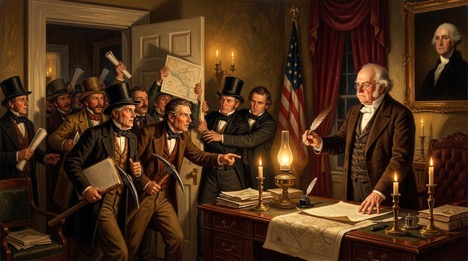
He does not argue about fish. He argues about the precedent.
“Establish the doctrine of bounties; set aside that part of the Constitution which requires equal taxes, and demands similar distributions; destroy this barrier; — and it is not a few fishermen that will enter, claiming ten or twelve thousand dollars, but all manner of persons; people of every trade and occupation may enter in at the breach, until they have eaten up the bread of our children.”
Williamson lost that vote, and the bill passed.
Two hundred and thirty-four years later, look around. Count the trades, the industries, the agencies, and the programs that have entered at that breach. Then look at what it has cost the people who pay for all of it.
This is the story of a single clause in the Constitution: how the men who wrote it meant it, how a line of presidents stood guard over it, and how it was finally opened wide enough to drive an empire through.
The General Welfare Clause: What the Founders Actually Wrote
Here are the words, from Article I, Section 8, Clause 1:
“The Congress shall have Power To lay and collect Taxes, Duties, Imposts and Excises, to pay the Debts and provide for the common Defence and general Welfare of the United States; but all Duties, Imposts and Excises shall be uniform throughout the United States.”
Read it again slowly. Congress may tax. It may tax in order to pay debts and provide for the common defense and general welfare. Notice that the welfare is that “of the United States,” the Union as a whole, not of one state, one town, one trade, or one family.
That sentence became one of the most fought-over lines in American history. Two questions sit inside it:
- Is “general welfare” a separate power to do anything good for the country?
- Or does it describe the purpose of the taxing power, with the specific powers listed after it marking out what Congress may actually spend on?
The men who wrote and defended the Constitution answered the first question with a firm no.
Madison: “Few and Defined”
In 1788, opponents of the Constitution warned that this clause was a trap. They said it amounted to an unlimited commission for Congress to do whatever it called the general welfare.
James Madison, the man history calls the Father of the Constitution, answered them in Federalist No. 41:
“For what purpose could the enumeration of particular powers be inserted, if these and all others were meant to be included in the preceding general power?”
Why write a careful list of powers if one phrase at the top swallows the whole list? It makes no sense, Madison said. The general phrase is explained and limited by the particulars that follow it.
In Federalist No. 45 he gave the people his promise in plain words:
“The powers delegated by the proposed Constitution to the federal government are few and defined. Those which are to remain in the State governments are numerous and indefinite.”
Few and defined. That was the deal. On that promise, the states ratified.
Jefferson: Not “Ad Libitum”
Three years later, Secretary of State Thomas Jefferson wrote his opinion on the proposed national bank for President Washington (February 15, 1791). He took the clause apart word by word:
“They are not to lay taxes ad libitum for any purpose they please; but only to pay the debts or provide for the welfare of the Union. In like manner, they are not to do anything they please to provide for the general welfare, but only to lay taxes for that purpose.”
To read “general welfare” as a grant of power to do anything, Jefferson warned, would make all the listed powers useless. It would reduce the whole Constitution to a single phrase.
The Cod Fishery Debate, 1792: The Founders Name the Danger
Then came the fishermen.
In early 1792, Congress debated paying allowances to cod-fishing vessels. The sum was small. The principle was not, and the men who had built the Constitution knew it.
Madison rose and described, almost item by item, the government that would follow if Congress could spend on anything it labeled the general welfare:
“If Congress can apply money indefinitely to the general welfare, and are the sole and supreme judges of the general welfare, they may take the care of religion into their own hands; they may establish teachers in every state, county, and parish, and pay them out of the public treasury; they may take into their own hands the education of children, establishing in like manner schools throughout the union; they may assume the provision for the poor; they may undertake the regulation of all roads other than post roads; in short, every thing, from the highest object of state legislation, down to the most minute object of police, would be thrown under the power of Congress.”
Let’s read that list again: teachers, the education of children, provision for the poor, local roads. Madison was not guessing at abstractions. He was describing, two hundred years early, the federal budget we live under today.
A few weeks earlier he had put the whole matter in one sentence, in a letter to Edmund Pendleton (January 21, 1792):
“If Congress can do whatever in their discretion can be done by money, and will promote the general welfare, the Government is no longer a limited one, possessing enumerated powers, but an indefinite one, subject to particular exceptions.”
A limited government with a few listed powers, or an unlimited one with a few listed exceptions. Those were the two roads. Madison saw the fork clearly.
Williamson: “To Gratify One Part of the Union by Oppressing Another”
Then Hugh Williamson took the floor, and he brought the argument down from principle to the kitchen table.
The Constitution, he reminded the House, demands that duties be uniform and that direct taxes be shared out fairly among the states. Why? He told them:
“The clear and obvious intention of the articles mentioned was, that Congress might not have the power of imposing unequal burdens — that it might not be in their power to gratify one part of the Union by oppressing another.”
A bounty breaks that equality. Everyone pays in, but only a favored few draw out. Once that door opens, Williamson warned, it never closes. It is not a few fishermen who will come through it, “but all manner of persons; people of every trade and occupation may enter in at the breach, until they have eaten up the bread of our children.”
Jefferson’s Promise: “The Bread It Has Earned”
Nine years later, Jefferson took the oath as President. In his First Inaugural Address (March 4, 1801), he described the government Americans had been promised:
“…a wise and frugal Government, which shall restrain men from injuring one another, shall leave them otherwise free to regulate their own pursuits of industry and improvement, and shall not take from the mouth of labor the bread it has earned.”
Notice the image. Williamson warned of a government that would eat the bread of our children. Jefferson promised one that would not take the bread labor has earned. The founders kept returning to that picture: the loaf on a family’s table, earned by honest work, and the hand that reaches for it.
They had seen that hand before. In 1776, they had written it into the Declaration of Independence. We will come back to that.
The Veto Line: Eight Presidents Who Guarded the Treasury
Words on paper protect nothing unless someone stands behind them. For nearly a century, American presidents stood behind these. Again and again they told Congress the same thing: we may like this project, but the Constitution does not let us pay for it.
That is worth sitting with. These men were not against roads, canals, schools, or charity. Several of them openly favored the projects they stopped. They vetoed anyway, because they believed a good cause did not license a broken oath.
Jefferson, 1806: “Not Among Those Enumerated”
Jefferson never vetoed a bill. He did something just as telling. In his Sixth Annual Message (December 2, 1806), the Treasury was running a surplus, and he wanted to spend it on education, roads, rivers, and canals. But he told Congress it could not do so without first asking the people:
“I suppose an amendment to the Constitution, by consent of the States, necessary, because the objects now recommended are not among those enumerated in the Constitution, and to which it permits the public moneys to be applied.”
A president with money in hand, wanting to do good, asked the states for permission first. That was the standard.
Madison, 1817: “Nugatory and Improper”
On his last full day in office (March 3, 1817), Madison vetoed the Bonus Bill, which would have funded roads and canals across the states. He supported the projects. He would not accept the reasoning:
“To refer the power in question to the clause ‘to provide for the common defense and general welfare’ would be contrary to the established and consistent rules of interpretation, as rendering the special and careful enumeration of powers which follow the clause nugatory and improper.”
And he named exactly what was at stake:
“Such a view of the Constitution would have the effect of giving to Congress a general power of legislation instead of the defined and limited one hitherto understood to belong to them.”
Monroe, 1822: “General, Not Local; National, Not State”
James Monroe vetoed a bill to put toll gates on the Cumberland Road (May 4, 1822), “approving as I do the policy,” because Congress lacked the power to run and police a road inside the states.
Monroe is an honest witness, so hear all of him. In a paper he sent with the veto, he gave ground that Madison never gave. He argued that Congress could appropriate money broadly, but drew a hard line around it:
“…restricted only by the duty to appropriate it to purposes of common defense and of general, not local, national, not State, benefit.”
That line, general, not local; national, not state, became the test that later presidents applied again and again.
Jackson, 1830 and 1834: “This Dangerous Doctrine”
Andrew Jackson vetoed the Maysville Road bill (May 27, 1830). The road ran sixty miles, entirely inside Kentucky. Jackson saw where calling it “national” would lead:
“…if it can be considered national, that no further distinction between the appropriate duties of the General and State Governments need be attempted, for there can be no local interest that may not with equal propriety be denominated national.”
If a local road is national, then everything is national, and the line between federal and state disappears.
Four years later, in his Sixth Annual Message (December 1, 1834), Jackson looked back on the whole fight over internal improvements. His words read like a warning written for our time. He spoke of how the issue had furnished “sinister appeals to selfish feelings,” and of its use “to the purposes of personal ambition.” He recalled that “this dangerous doctrine” had once seemed headed for final victory “with fearful rapidity.” He told Congress the Constitution gave it no power to build “ordinary roads and canals within the limits of a State.”
Then he said something every American should know:
“But against the dangers of unconstitutional acts which, instead of menacing the vengeance of offended authority, proffer local advantages and bring in their train the patronage of the Government, we are, I fear, not so safe.”
That is the whole danger in one sentence. A free people will resist a tyrant who threatens them. They are far less ready to resist a government that pays them. Liberty is rarely seized at gunpoint. More often it is traded away for a local favor.
Polk, 1846 and 1847: “A Disreputable Scramble for the Public Money”
James K. Polk vetoed a rivers and harbors bill on August 3, 1846. He described, with almost painful accuracy, how a modern spending bill is passed:
“It will produce combinations of local and sectional interests, strong enough when united to carry propositions for appropriations of public money which could not of themselves, and standing alone, succeed, and can not fail to lead to wasteful and extravagant expenditures.”
“It must produce a disreputable scramble for the public money by the conflict which is inseparable from such a system between local and individual interests and the general interest of the whole.”
The next year (December 15, 1847) he went further, and named the reward that would drive it:
“The true interests of the country would be lost sight of in an annual scramble for the contents of the Treasury, and the Member of Congress who could procure the largest appropriations to be expended in his district would claim the reward of victory from his enriched constituents.”
And he warned where it would end: “combinations of individual and local interests will be found strong enough to control legislation, absorb the revenues of the country, and plunge the Government into a hopeless indebtedness.”
Hopeless indebtedness. Hold on to that phrase. We will see what it looks like in Part 2.
Pierce, 1854: “The Great Almoner of Public Charity”
In 1854 Congress passed a bill championed by Dorothea Dix, one of the great reformers of the age. It would have granted federal land to fund asylums for the mentally ill poor. The cause was noble. Franklin Pierce vetoed it on May 3, 1854:
“…I can not find any authority in the Constitution for making the Federal Government the great almoner of public charity throughout the United States.”
Then he described exactly what would happen to the states if Washington took up charity:
“…the fountains of charity will be dried up at home, and the several States, instead of bestowing their own means on the social wants of their own people, may themselves… become humble suppliants for the bounty of the Federal Government, reversing their true relations to this Union.”
The states, which created the Union, would become its beggars. Pierce saw it in 1854.
Buchanan, 1859 and 1860: “Greatly Deteriorated”
James Buchanan vetoed the first land-grant college bill on February 24, 1859. His reasoning goes straight to the heart of the question this series asks:
“Should the time ever arrive when the State governments shall look to the Federal Treasury for the means of supporting themselves and maintaining their systems of education and internal policy, the character of both Governments will be greatly deteriorated.”
He put the constitutional point bluntly: “I presume the general proposition is undeniable that Congress does not possess the power to appropriate money in the Treasury, raised by taxes on the people of the United States, for the purpose of educating the people of the respective States.”
The next year, vetoing an appropriation for the St. Clair Flats in Michigan (February 1, 1860), he restated the spirit of the whole design. The Constitution, he wrote, confines federal powers “chiefly to our intercourse with foreign nations, to questions of peace and war, and to subjects of common interest to all the States, carefully leaving the internal and domestic concerns of each individual State to be controlled by its own people and legislature.”
Cleveland, 1887: “The Government Should Not Support the People”
In 1887, drought ruined crops in several Texas counties. Congress passed a bill for $10,000 to buy seed grain for the stricken farmers. Grover Cleveland vetoed it on February 16, 1887.
He did not doubt the suffering. He doubted the authority:
“I can find no warrant for such an appropriation in the Constitution, and I do not believe that the power and duty of the General Government ought to be extended to the relief of individual suffering which is in no manner properly related to the public service or benefit.”
Then he wrote the line that has outlived him:
“…the lesson should be constantly enforced that though the people support the Government the Government should not support the people.”
And he explained why it mattered for the character of a free people:
“Federal aid in such cases encourages the expectation of paternal care on the part of the Government and weakens the sturdiness of our national character, while it prevents the indulgence among our people of that kindly sentiment and conduct which strengthens the bonds of a common brotherhood.”
Cleveland was not turning his back on Texas. He told Congress that the charity of the American people could be relied on to help fellow citizens in misfortune. He even suggested that members of Congress give the drought-stricken farmers the free seed the government already handed out to them each year. His point was about who should help: neighbors, churches, and communities, freely, not a Treasury that taxes everyone to favor some.
The Line They Held
| Year | President | What he stopped or refused | His reason in brief |
| 1806 | Jefferson | Spending surplus on roads, canals, education without an amendment | “Not among those enumerated” |
| 1817 | Madison | Bonus Bill: federal roads and canals | Would make the enumeration “nugatory” |
| 1822 | Monroe | Toll gates on the Cumberland Road | “General, not local; national, not State” |
| 1830 | Jackson | Maysville Road, inside Kentucky | No local interest that can’t be called national |
| 1846 / 1847 | Polk | Rivers and harbors bills | “A disreputable scramble for the public money” |
| 1854 | Pierce | Land for asylums for the indigent insane | Not “the great almoner of public charity” |
| 1859 / 1860 | Buchanan | Land-grant colleges; St. Clair Flats | States would “look to the Federal Treasury” |
| 1887 | Cleveland | $10,000 for Texas seed grain | “The Government should not support the people” |
For almost a century, the line held. Then the country began to change the way it read the clause.
The Other Reading: Hamilton, Story, and the Court That Chose Between Them
Not every founder read the clause as Madison did. To understand how we got here, we have to hear the other side at full strength.
Hamilton: “More Than Was Expressed”
Alexander Hamilton, Washington’s Treasury Secretary, laid out the broad reading in his Report on Manufactures (December 5, 1791):
“The terms ‘general Welfare’ were doubtless intended to signify more than was expressed or imported in those which Preceded…”
Hamilton argued that a nation faces needs no list can foresee. Congress must be free to spend on them, even outside the listed powers. On this view, the power to spend reaches further than the power to regulate.
But even Hamilton drew a line, and it is the same line Williamson drew:
“…That the object to which an appropriation of money is to be made be General and not local; its operation extending in fact, or by possibility, throughout the Union…”
Remember this. The broadest reading the founding generation ever gave the clause still forbade spending on local objects. Hamilton’s general welfare was the welfare of the whole Union, not of one district, one industry, or one well-connected interest.
Story: Not for the “Special, or Local”
Justice Joseph Story, the great legal scholar of the early Republic, largely sided with Hamilton in his Commentaries on the Constitution (1833). Yet he kept the same limit. A tax laid for a purpose that is “special, or local, as contradistinguished from national,” he wrote, “is not within the scope of the constitution” (§919).
So the founding-era debate was never between “limited” and “unlimited.” It was between Madison’s narrow road and Hamilton’s wider one. Both roads had a wall at the edge marked local.
1936: The Court Picks Hamilton
The question sat unresolved in the courts for 145 years. Then, in the depths of the Depression, the Supreme Court settled it.
In United States v. Butler (1936), the Court formally adopted Hamilton’s view:
“It results that the power of Congress to authorize expenditure of public moneys for public purposes is not limited by the direct grants of legislative power found in the Constitution.”
Madison’s reading lost. Yet Butler still struck down the farm program before it, holding that regulating agricultural production belonged to the states.
One year later, in Helvering v. Davis (1937), the Court upheld Social Security. Justice Cardozo wrote words that opened the door the rest of the way:
“Nor is the concept of the general welfare static.”
If the meaning is not fixed, it moves wherever Congress moves it. And Congress, the Court said in the same era, would largely be the judge of what the general welfare requires.
Buying What Cannot Be Commanded
Once Congress could spend on nearly anything, the next question was whether it could attach strings. Could Washington pay the states to do what it had no power to order them to do?
In South Dakota v. Dole (1987), the Court said yes. Congress could withhold highway money from states that would not raise their drinking age to 21. The Court warned only that a grant must not be so coercive “as to pass the point at which ‘pressure turns into compulsion.'”
For twenty-five years, no federal grant was ever found to cross that line. Then came NFIB v. Sebelius (2012). Congress had threatened to cut off all existing Medicaid funding to any state that refused the Medicaid expansion. Chief Justice Roberts wrote that this was not encouragement:
“…it is a gun to the head.”
It was the first time the Court struck down a spending condition as coercive. It remains a narrow limit on a nearly boundless power.
Where That Leaves Us
Here is the honest scorecard:
- Under Madison’s reading, the bulk of what Washington now sends to the states (schools, welfare, health, local roads, local projects) lies outside the Constitution. Madison named most of these items by name in 1792.
- Under Hamilton’s reading, the test is “general and not local.” Much spending could pass that test. But earmarks, district projects, and payments to particular industries and favored firms fail even Hamilton’s own standard.
- Under current law, Madison’s reading lost in 1936. Today’s legal fight is over strings and coercion, not over whether Congress may spend.
The founders’ warnings did not become wrong in 1936. They became law’s losing side. Whether they were right is a question every citizen can still answer for himself, by looking at what came through the breach.
The Declaration’s Mirror: Grievances of 1776
Sixteen years before Williamson warned of a government that would eat “the bread of our children,” the Continental Congress had already used the same image. In the Declaration of Independence, among the charges against the King:
“He has erected a multitude of New Offices, and sent hither swarms of Officers to harass our people, and eat out their substance.”
Eat out their substance. The founders knew what it felt like to be fed upon by a government they did not control. They built the Constitution so it would never happen again.
The Declaration is more than a list of complaints against one king. It is a catalog of the ways any power slips its limits. Read a few of its charges beside the record of the last century, and judge for yourself how far we have drifted.
“He Has Made Judges Dependent on His Will Alone”
“He has made Judges dependent on his Will alone, for the tenure of their offices, and the amount and payment of their salaries.”
The colonists understood a simple truth: whoever controls your pay controls your judgment. A judge who depends on the Crown for his salary will not rule against the Crown for long.
Now look at the states. In fiscal 2024, federal funds made up about 34 percent of all state spending. A state that depends on Washington for a third of its budget is in the position of those colonial judges. Pierce warned the states would become “humble suppliants.” Buchanan warned they would “look to the Federal Treasury.” They were describing dependence, and dependence is what we have.
The charge reaches inside the federal government too. For decades, many Americans facing federal agencies were judged in the agency’s own in-house courts, by officials the agency itself employs. Only in 2024 (SEC v. Jarkesy) did the Supreme Court hold that Americans facing SEC civil penalties for fraud are entitled to a jury in a real court.
“For Depriving Us in Many Cases, of the Benefits of Trial by Jury”
That is the Declaration’s very next point. The colonists listed the loss of jury trials as a grievance worth a revolution. The Jarkesy case shows how far that right had eroded before the Court restored part of it.
“He Has Forbidden His Governors to Pass Laws… Till His Assent Should Be Obtained”
“He has forbidden his Governors to pass Laws of immediate and pressing importance, unless suspended in their operation till his Assent should be obtained.”
Today this is how federal grants work. A state that takes Medicaid money must have its state plan, and every major change to it, approved in Washington. Highway funds were withheld until states raised their drinking age (South Dakota v. Dole). Education grants have carried federal conditions on standards and testing. The states’ own laws wait on a distant assent, because the money waits on it.
“For Imposing Taxes on Us Without Our Consent”
“For imposing Taxes on us without our Consent.”
There are now two ways Americans are taxed without voting on it.
The first is inflation. Milton Friedman put it plainly: inflation, he said, “is the one form of taxation that can be imposed without legislation.” No representative casts a vote for it. It simply arrives, in every grocery bill and every paycheck.
The second is borrowing. Every dollar of debt is a tax on Americans not yet old enough to vote, or not yet born. Jefferson called it by its right name in 1816: “the principle of spending money to be paid by posterity, under the name of funding, is but swindling futurity on a large scale.”
“Standing Armies Without the Consent of Our Legislatures”
“He has kept among us, in times of peace, Standing Armies without the Consent of our Legislatures.”
The Constitution gives Congress alone the power to declare war. Congress last used it on June 5, 1942. Since then America has fought in Korea, Vietnam, the Gulf, Afghanistan, Iraq, and many smaller conflicts. Congress has sometimes voted authorizations for these. It has never again voted a declaration of war.
“For Suspending Our Own Legislatures”
“For suspending our own Legislatures, and declaring themselves invested with power to legislate for us in all cases whatsoever.”
In 1973 a special committee of the United States Senate studied the emergency powers that had piled up since 1933. Its report found that those powers, taken together, “confer enough authority to rule the country without reference to normal constitutional processes.” That is the Senate of the United States speaking about its own government, not a pamphleteer.
Part 2 tells how that happened.
The Grievances Side by Side
| The charge of 1776 | What the founders meant | Where we see it now |
| “Swarms of Officers to… eat out their substance” | A swollen bureaucracy living off the people | About 2.3 million federal civilian employees (2025); over 100,000 pages added to the Federal Register in 2024 alone |
| “Judges dependent on his Will alone… payment of their salaries” | Whoever pays you controls you | States depend on Washington for about one-third of their spending |
| “Forbidden his Governors to pass Laws… till his Assent” | Local law held hostage to distant approval | Federal sign-off on state Medicaid plans; strings on highway and school money |
| “Depriving us… of Trial by Jury” | Rights decided without a jury of peers | Agency in-house courts, partly reined in by SEC v. Jarkesy (2024) |
| “Imposing Taxes on us without our Consent” | Taxation without representation | Inflation and debt passed to the unborn |
| “Standing Armies without the Consent of our Legislatures” | Military power outside the people’s control | No declaration of war since 1942 |
| “Suspending our own Legislatures” | Rule by decree | A Senate report: emergency powers enough “to rule the country without reference to normal constitutional processes” |
The founders pledged their lives, their fortunes, and their sacred honor to be free of these things. The question for us is simpler: will we even notice them?
